
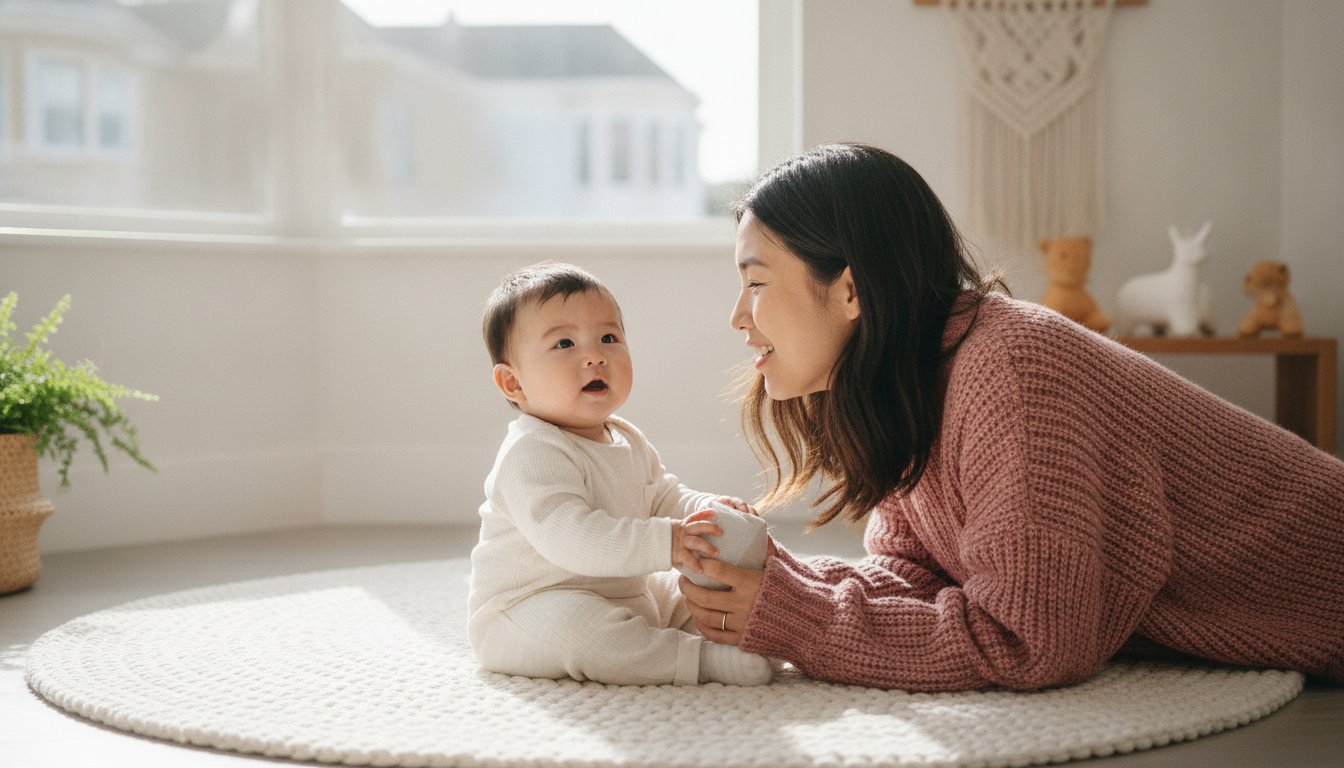
There’s a quiet magic in the air when you’re waiting for your baby’s first word. You lean in closer during every coo and babble, wondering if that was the one. Is “da-da” just a sound, or does he really mean his dad? Is that little gurgle a laugh or the start of a greeting? This journey from silent kicks in the womb to their first clear “Mama” is one of the most incredible transformations to witness.
But in a world of milestone charts and social media updates, it’s easy for that sweet anticipation to curdle into anxiety. You might find yourself wondering, when does a baby talk, really? And am I doing enough to help them?
Take a deep breath. Language isn’t a race to be won; it’s a beautiful, continuous conversation that begins with your baby’s first breath and thrives on the warmth of your unique bond. This guide is here to walk you through the timeline, demystify the process, and give you gentle, expert-backed ways to support their journey from coos to conversations.
From Womb to First Words: The Secret Language of Infants
Speech development begins long before the first ‘Mama’ as your baby tunes into your voice. Even in the final trimester, your baby is already listening, growing familiar with the specific rhythm and melody of your speech. Research from the National Institutes of Health (NIH) suggests that newborns can already tell the difference between their native language and a foreign one, all based on these early auditory patterns.
This “pre-speech” stage is their first foray into communication. Every cry, every bit of eye contact, and every soft coo is a form of talking. They are telling you they’re hungry, tired, or just want to be close to you. Then, around 4 to 6 months, you’ll start to see a shift toward more intentional communication, where they make a sound or gesture specifically to get your attention.
And that sweet, high-pitched “parentese” you find yourself using? It’s a powerful teaching tool. Keep it up—you’re speaking their language.
The Power of the ‘Parentese’ Voice
When you talk to your baby, you likely raise the pitch of your voice and speak in a more melodic, sing-song way. This is called parentese, and it’s incredibly effective. That exaggerated tone helps your baby’s developing brain map the sounds of language and distinguish individual words within a stream of speech.
It’s important to know the difference between “baby talk” (using nonsense words like “goo-goo ga-ga”) and “parentese” (using real words with an exaggerated melody). While both can be fun, parentese is what truly builds their vocabulary. A simple way to practice this is by narrating your day. During a diaper change, you could say, “Let’s get a clean diaper! We’ll wipe you all clean. There, all done!”
Recognizing the Early Coos and Gurgles
Around 2 months, your baby’s reflexive crying will start to be joined by delightful, vowel-heavy cooing sounds like “ahhh” and “oooo.” This is a huge step! They are learning to control their vocal cords and are discovering their own voice.
The best thing you can do is engage in “serve and return” interactions. When your baby coos, you coo back. When they make a sound, you respond with a smile and words. Research suggests these early “conversations” are fundamental for building the brain’s social and emotional circuitry, laying the foundation for all future communication.
Tracking the Milestones: Your Baby’s Speech Timeline
While every child follows their own unique path, most babies hit these key vocal markers in their first two years. Remember, these are guidelines, not deadlines. Your little one is focused on so many developmental tasks at once, from learning to roll over to mastering that pincer grasp.
- 6-9 Months (Babbling): This is when you’ll start hearing polysyllabic sounds, like the classic “ba-ba-ba” or “da-da-da.” They’re experimenting with combining consonants and vowels.
- 12 Months (First Word): Around their first birthday, many babies make the incredible leap from random sounds to words with specific meaning. They say “ma-ma” while looking right at you.
- 18-24 Months (Word Explosion): In this exciting phase, their vocabulary can grow exponentially. They begin combining two words into mini-sentences like “more milk” or “go bye-bye.”
It’s helpful to use cautious phrasing like “research suggests most children” will hit these marks around these times. This isn’t a race, and your baby will get there on their own perfect schedule.
The 6 to 9 Month Babble Phase
This phase is marked by what experts call “canonical babbling”—those repetitive consonant-vowel strings like “mamama” or “bababa.” It’s a joy to listen to! You may also notice your baby starting to imitate the inflections and tones of your speech. Even though they aren’t using real words, their babbles might rise at the end as if asking a question.
A wonderful way to encourage this is to mimic their sounds back to them. If they say “bababa,” you say “bababa” right back with a big smile. This shows them that their sounds have meaning and that you’re engaged in a conversation with them.
The Magic of the First Birthday and Beyond
So, what counts as a “real” first word? Experts look for two things: consistency and intent. If your baby says “baba” every time they want their bottle, that’s a word! Common first words often include “Mama,” “Dada,” “dog,” “ball,” or “uh-oh,” because they relate to their immediate needs, favorite people, and daily observations.
These early language lessons often happen during quiet, routine moments, like feeding time. While figuring out how to get a free breast pump through insurance is a practical step for many new parents, it’s those intimate feeding sessions—whether by breast or bottle—that create the perfect, focused environment for modeling your first words.
Walking vs. Talking: Debunking a Common Myth
You’ve probably heard the old saying: babies can only master one big skill at a time, so they’ll either be an early walker or an early talker. It’s a common belief, and it can sometimes seem true when your little one suddenly masters crawling and their babbling seems to take a backseat for a week.
However, this is largely a misconception. A baby’s brain is developing at an explosive rate, working on motor skills, language, and social skills all at once. While it’s true that a baby might dedicate a lot of brainpower to mastering a physical skill like pulling up to stand, it doesn’t mean their language development has stopped. More often, it’s just happening more quietly in the background.
It’s helpful to remember that just as the timeline for when a baby starts to walk is wonderfully varied, so is their speech journey. The key is to look at their overall progress. If they are continuing to learn, engage, and hit other milestones, a temporary lull in one area while another surges is usually just a normal part of their incredible development.

Receptive vs. Expressive Language: Understanding Before Speaking
Your baby’s ability to understand your words often develops much faster than their ability to say them back. This can be a source of worry if you don’t realize what’s happening beneath the surface. It’s helpful to think of language in two parts: receptive and expressive.
- Receptive language is the ability to understand. It’s your baby processing information—comprehending your tone of voice, recognizing their own name, and following simple instructions.
- Expressive language is the ability to communicate back. It’s the physical act of coordinating the lips, tongue, and breath to produce sounds and words.
The “gap” between these two skills exists because the cognitive work of understanding is less complex than the fine motor skills required for speech. A baby who can point to a ball when you ask, “Where’s the ball?” is hitting a major language milestone, even if they can’t say the word “ball” yet.
Signs Your Baby Understands You
Long before they can talk, your baby will show you they understand. Keep an eye out for these wonderful “quiet milestones,” as they are just as important as the vocal ones. They might:
- Turn their head when you call their name.
- Look toward the family dog when you say, “Where’s the puppy?”
- Follow a simple command like, “Give me the toy.”
- Engage in “joint attention,” where you both look at the same object after you point to it. This shared focus is a critical precursor to talking.
Celebrating these moments helps you recognize just how much your little one is already communicating, even without words.
Bridging the Gap with Gestures
Gestures are a vital bridge between understanding and speaking. Pointing, waving “bye-bye,” and clapping their hands are all powerful forms of expressive language. They allow your baby to communicate their wants and needs, which can reduce frustration for everyone.
Some parents explore baby sign language during the 10- to 14-month window to give their child more tools for expression. Far from hindering speech, research from the Mayo Clinic suggests that using signs may actually help support verbal development by reinforcing the idea that actions and objects have names.
Playful Ways to Encourage Your Little One’s Voice
You don’t need fancy flashcards or expensive apps to help your baby talk; simple, daily interactions are the best classroom. Your voice, your face, and your attention are the only tools you really need.
The “narrative approach” is one of the easiest and most effective methods. Simply talk through your day as you go about your tasks. “I’m putting your red socks on now. One sock, two socks!” Or, “Let’s put the apples in the cart. They’re so shiny and round.” Reading aloud is also incredibly important, even if your baby just wants to chew on the corner of the board book. And don’t forget to sing! Repetitive songs with simple melodies are fantastic for language learning. Try pausing before the last word of a familiar line (“Twinkle, twinkle, little…”) to see if they’ll try to fill in the blank.
The Best ‘Toys’ for Talkers
The best toys for language development are often the simplest. Open-ended toys like blocks, baby dolls, or toy animals encourage imaginative play and “dialogue” as your child grows. A simple, unbreakable mirror is also a fantastic tool; babies are fascinated by watching their own mouths move as they make sounds.
While you might be researching the latest tech for your nursery, like what’s in our 2026 baby monitor guide, it’s important to remember that no gadget can replace face-to-face time. The American Academy of Pediatrics recommends limiting screen time for children under 18 months, as real-life interaction is far superior for language growth.
Making Reading a Daily Ritual
Reading to your baby from day one is one of the greatest gifts you can give them. It’s not about finishing the story; it’s about the shared experience. The goal is the sound of your voice, the rhythm of the words, and the cozy time spent together.
- Engage them with the book: Point to the pictures and name what you see. “Look at the big, yellow sun!” Make the animal sounds. Let them help you turn the sturdy pages of a board book.
- Choose the right books: Newborns love high-contrast, black-and-white images. Older infants enjoy tactile “touch-and-feel” books or books with flaps. As they grow, you can explore some of the best books for toddlers to encourage early learning.
When to Call the Pediatrician: Navigating Speech Delays with Calm
If you have a gut feeling that something isn’t quite right with your baby’s development, a gentle conversation with your pediatrician is always the best first step. You know your child better than anyone, and your intuition is a powerful tool.
While many “late talkers” catch up on their own, early intervention can be a powerful resource if there is an underlying issue. A common first step is a hearing check, as frequent ear infections can sometimes muffle sound and make it harder for a child to learn language. Remember that seeking support is a sign of proactive, loving parenting, not a label. We’re here with you as your long-term companion through every developmental twist and turn.
Common Red Flags by Age
The American Academy of Pediatrics provides guidelines to help parents and doctors spot potential delays. Remember, these are just guidelines, not absolute deadlines. Talk to your doctor if you notice the following:
- By 6-9 months: Not babbling or responding to their name.
- By 12 months: Not using gestures like pointing or waving.
- By 15-18 months: Has not said their first word.
- By 24 months: Has a vocabulary of fewer than 50 words or is not combining two words together.
Trust your instincts. It’s always better to ask a question and be reassured than to worry in silence.
What to Expect in a Speech Evaluation
The thought of an “evaluation” can sound intimidating, but it’s usually a very gentle and play-based process. A specialist, called a Speech-Language Pathologist (SLP), will likely just play with your child, observing how they communicate nonverbally and vocally.
An SLP’s role is to provide help, not “fixes.” They can offer tailored games and strategies to encourage your child’s speech in a fun, low-pressure way. Many states also offer free “Early Intervention” programs for children under three who qualify. This support system is there to help your child thrive, and accessing it early can make all the difference.
Disclaimer
Pregnancy Magazine content is based on the latest research and information available, but is not meant to be medical advice or instruction. See a medical professional for direction for your specific situation or case.
We strive to be objective in our buyer's guide reviews and usually compare a variety of products in a category. Pregnancy Magazine is supported by sales from referring links.


