
Looking in the mirror after having a baby can feel like meeting a stranger. Your body has done something incredible, but the reflection staring back might feel weak, disconnected, or just… different. If you’ve noticed a soft gap or a slight bulge in your stomach, you’re not alone, and your body isn’t broken. You’re likely experiencing diastasis recti, a completely normal part of the postpartum journey.
The good news is that healing is not only possible, but it’s also an opportunity to reconnect with your body in a new, powerful way. It’s not about frantically trying to “close the gap,” but about gently rebuilding your core from the inside out.
This guide will walk you through safe, effective diastasis recti exercises for beginners. We’ll focus on the foundational breathwork that makes all the difference, show you which common exercises to avoid, and provide a simple routine to help you restore your core strength with confidence.
What is Diastasis Recti? Understanding Abdominal Separation
This guide explains the common condition of abdominal separation after pregnancy and how to assess your own core for functional healing.
- Diastasis recti is the stretching of the connective tissue (the linea alba) that runs down the midline of your abdomen, between your “six-pack” muscles.
- During pregnancy, your body creates space for your growing baby by stretching this tissue, which can result in a midline gap known as diastasis recti.
- It’s an incredibly common part of the postpartum experience. In fact, some research suggests that up to about 60% of women may have some degree of diastasis recti around six weeks postpartum.
- True healing is less about the width of the gap and more about restoring tension and function to the connective tissue, allowing your core to work properly again.
How to Check Yourself for Diastasis Recti at Home
You can perform a simple self-check to get a sense of what’s happening with your core. Just remember to be gentle with yourself.
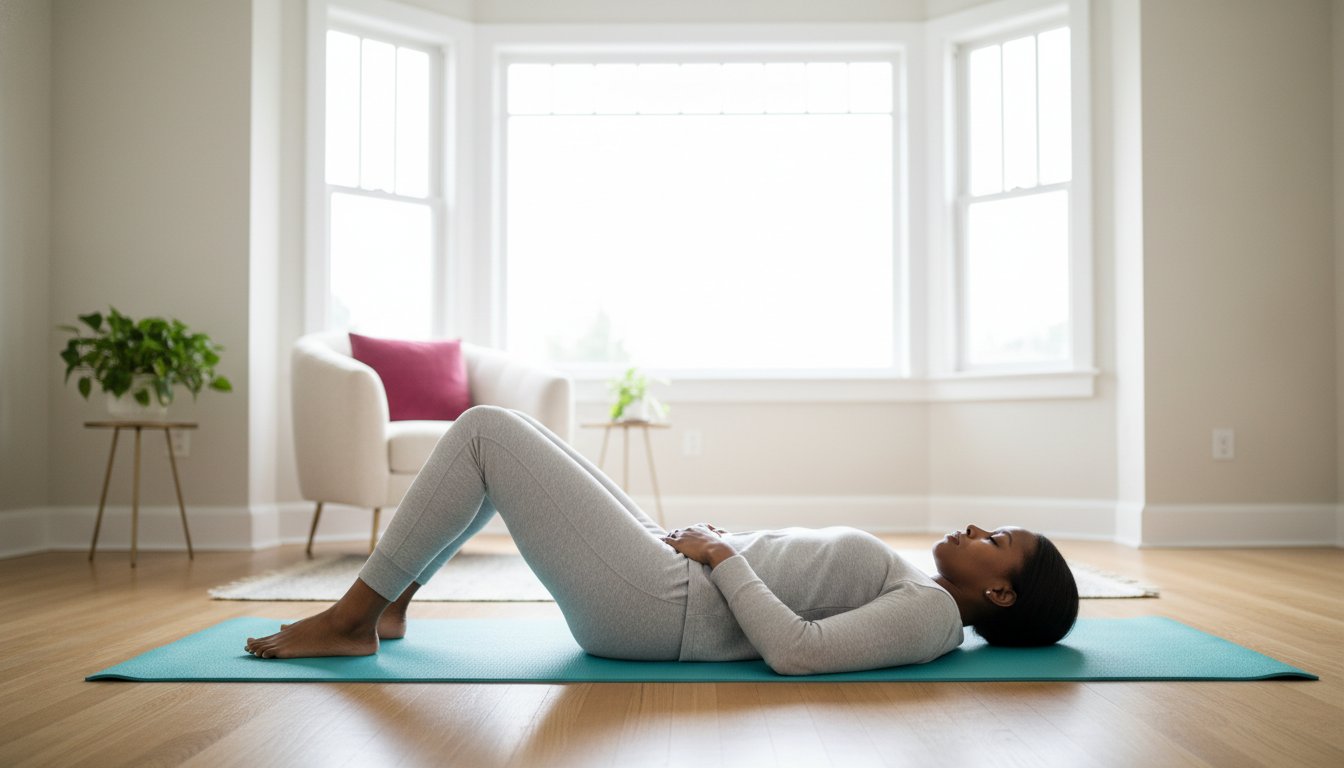
- Lie on your back with your knees bent and your feet flat on the floor, just as if you were about to do a glute bridge.
- Place the fingertips of one hand horizontally across your midline at your belly button.
- Gently press down and slowly lift your head and shoulders just a few inches off the floor, as if starting a crunch. Don’t come up all the way.
- Feel for a separation between the edges of your abdominal muscles. You’re assessing both the width (how many fingers fit) and the depth (how soft or deep it feels). A small, shallow gap is often perfectly normal.
Why the ‘Gap’ Isn’t the Only Thing That Matters
It’s easy to get fixated on the number of fingers you can fit in the gap, but that’s not the whole story. The real goal is functional strength.
- Focus on the tension of the connective tissue. When you lift your head, does it feel firm and taut like a trampoline, or soft and deep?
- A shallow, firm gap is often a sign of a more functional core than a narrow but very deep, soft one.
- Functional healing means your core can properly manage pressure during daily activities, like lifting your baby or getting out of a chair, without pain or bulging.
The Foundation of Healing: Breath and the Transverse Abdominis
Before you even think about specific exercises, the most critical first step is learning to breathe correctly and engage your deepest core muscle.
Your Transverse Abdominis (TvA) is your body’s natural corset. It wraps around your midsection, and learning to activate it is the key to stabilizing your core. Proper breathing helps manage the intra-abdominal pressure that can otherwise push outward on your healing linea alba. The golden rule is to always exhale on the “effort” part of any movement to protect your core.
Mastering the Diaphragmatic ‘360’ Breath
This isn’t just any deep breath; it’s about re-learning how your core and diaphragm are designed to work together.
- As you inhale, feel your rib cage expand in all directions—to the front, out to the sides, and into your back.
- Try to avoid shallow “chest breathing,” which can keep your body in a stressed state and doesn’t fully engage your diaphragm.
- Imagine your torso is a canister filling with air from the bottom up, expanding 360 degrees around.
The ‘Connection Breath’ for Core Activation
This is where the magic happens. You’ll coordinate that 360-degree breath with a gentle activation of your deep core and pelvic floor.
- Take a deep 360-degree inhale.
- As you exhale, imagine you are gently zipping up a pair of snug, high-waisted jeans from the bottom up.
- Feel your lower abs draw in and up, away from your waistband, without tucking your tailbone or clenching your glutes.
- At the same time, gently lift your pelvic floor, like you’re picking up a blueberry with your vagina. This exhale is your core engagement.
Movements to Skip: Why Crunches May Hinder Your Progress
Knowing what not to do is just as important as knowing what to do, especially in the early stages of healing.
Certain movements create too much forward, outward pressure on the abdominal wall, which can delay healing or even make the separation worse. If you’re a beginner, it’s best to avoid these until you’ve rebuilt your foundational core strength with a professional’s guidance.
- Standard Crunches & Sit-ups: These create a forceful forward bulge that your healing connective tissue may not be ready to handle.
- Traditional Planks: A full plank can be too demanding for a weakened core, causing your stomach to hang and strain the midline.
- Heavy Lifting & Intense Twisting: Avoid these until you can maintain your “connection breath” and core engagement automatically.
- Any movement that causes “coning”: This is your body’s most important signal to stop or modify an exercise.
Identifying ‘Coning’ or ‘Doming’ During Exercise
Coning is the most obvious sign that an exercise is too challenging for your core at its current strength level.
- Look for a triangular or bread-loaf-shaped ridge that protrudes down the center of your abdomen during a movement.
- This happens when intra-abdominal pressure pushes out through the weakest point—the stretched linea alba.
- If you see coning, stop the exercise immediately. You can try a smaller range of motion or a more modified version of the move.
Safe Ways to Get Out of Bed and Off the Floor
You can protect your midline dozens of times a day just by changing how you get up from a lying position.
- Avoid the “jackknife” motion of sitting straight up, which is essentially a full sit-up.
- Instead, use the “log roll” technique. Roll onto your side, then use your arms to push yourself up to a seated position.
- This simple habit takes all the direct pressure off your abdominal wall.

Gentle Diastasis Recti Exercises: Your Step-by-Step Beginner Routine
This gentle routine focuses on re-establishing the connection between your brain, your breath, and your deep core muscles.
Aim to perform these movements 3–5 times a week, always prioritizing slow, controlled form over the number of repetitions. Start every session with a few rounds of your “connection breath” to wake up your TvA. If you ever feel pain or see coning, stop and rest.
-
Step 1: Pelvic Tilts and Heel Slides
- Lie on your back with your knees bent and feet flat on the floor in a neutral spine position.
- Pelvic Tilt: Inhale to prepare. As you exhale, use your deep abs to gently flatten your lower back toward the floor without lifting your hips. Inhale to return to neutral.
- Heel Slide: After a pelvic tilt, hold the gentle core engagement. On your next exhale, slowly slide one heel away from you along the floor. Only go as far as you can without your pelvis rocking or your back arching. Inhale as you slide it back in. Alternate legs.
-
Step 2: Glute Bridges with Core Engagement
- Staying on your back, place your arms at your sides.
- Inhale to prepare. As you exhale, engage your core with the “zipper” cue and gently squeeze your glutes to lift your hips toward the ceiling.
- Focus on creating a straight line from your knees to your shoulders. Avoid over-arching your back.
- Inhale as you slowly lower your hips back down one vertebra at a time.
-
Step 3: Modified Bird-Dog for Stability
- Start on all fours with your hands under your shoulders and knees under your hips. Keep your back flat and your neck long.
- Inhale to prepare. As you exhale, engage your core and slowly slide one arm forward along the floor. The goal is to keep your torso and hips perfectly still.
- Inhale to slide your arm back. Exhale and repeat with the other arm.
- Once you’ve mastered the arms, try sliding one leg straight back along the floor. The key is preventing any shifting or dipping in your hips.
Beyond the Mat: Integrating Core Healing Into Daily Life
Your 10-minute workout is important, but the real healing happens during the other 23 hours of the day.
True core recovery comes from being mindful of your movements throughout the day. By applying the same principles of breath and engagement to everyday tasks, you reinforce the healing process and build functional strength that truly serves you in your life as a mom.
Building Your Postpartum Support Team
You don’t have to navigate this journey alone. Building a support system is a crucial part of your recovery.
- Consider seeing a pelvic floor physical therapist. They are experts in postpartum recovery and can give you a personalized assessment and treatment plan that an article simply cannot.
- A therapist can provide hands-on cues to help you connect with your muscles correctly and ensure you are progressing safely. For a more general overview, you can also check out this gentle, expert-backed guide for returning to exercise after pregnancy.
- While focusing on physical recovery, ensure you have the right tools to ease your daily routine, like checking your eligibility for a free breast pump through insurance.
When to Expect Results and When to See a Doctor
Healing is a journey, not a race. Be patient and celebrate small victories along the way.
- With consistent practice, many moms notice improved core function and a firmer-feeling midline within 6 to 12 weeks.
- It’s a good idea to discuss your recovery with your provider, especially at your 6-week postpartum checkup.
- Seek professional help if you experience ongoing pelvic pain, urinary or fecal incontinence, a persistent feeling of pressure or bulging in your pelvis, or if the separation doesn’t seem to be improving at all.
Frequently Asked Questions
Is it ever too late to start diastasis recti exercises?
No, it’s never too late! While starting in the early postpartum period is ideal, these foundational exercises can help improve core function and tension years after giving birth.
Can I heal diastasis recti without surgery?
Absolutely. Most cases of diastasis recti can be significantly improved with corrective exercise and physical therapy. Surgery is typically considered a last resort for severe cases that cause functional issues.
How often should a beginner do these exercises?
A good starting point is 3 to 5 days a week for about 10-15 minutes. Consistency is more important than intensity. Listen to your body and rest when you need to.
Is it safe to exercise with diastasis recti while breastfeeding?
Yes, it is generally safe. Gentle core exercises like the ones described here should not impact your milk supply. Just be sure to stay hydrated and listen to your body’s energy levels.
What are the first signs that my diastasis recti is healing?
You may first notice that your core feels more stable when you move. When you do a self-check, the gap might feel shallower or the connective tissue might feel firmer and more responsive. A visible reduction in “mummy tummy” or bulging is also a positive sign.
Can wearing a postpartum belly wrap help close the gap?
A wrap or binder can provide external support and may help with body awareness, but it won’t actively heal the separation on its own. It should be used as a supportive tool in conjunction with, not as a replacement for, corrective exercises.
What happens if I ignore my abdominal separation?
If left unaddressed, a significant diastasis recti can contribute to a weak core, which may lead to issues like chronic lower back pain, pelvic instability, and poor posture.
How do I know if an exercise is making my diastasis recti worse?
The biggest red flag is “coning” or “doming” down the midline of your abdomen. Other signs include any kind of pain in your abdomen or back, or a feeling of pressure pushing down on your pelvic floor during the movement.
Disclaimer
Pregnancy Magazine content is based on the latest research and information available, but is not meant to be medical advice or instruction. See a medical professional for direction for your specific situation or case.
We strive to be objective in our buyer's guide reviews and usually compare a variety of products in a category. Pregnancy Magazine is supported by sales from referring links.


