
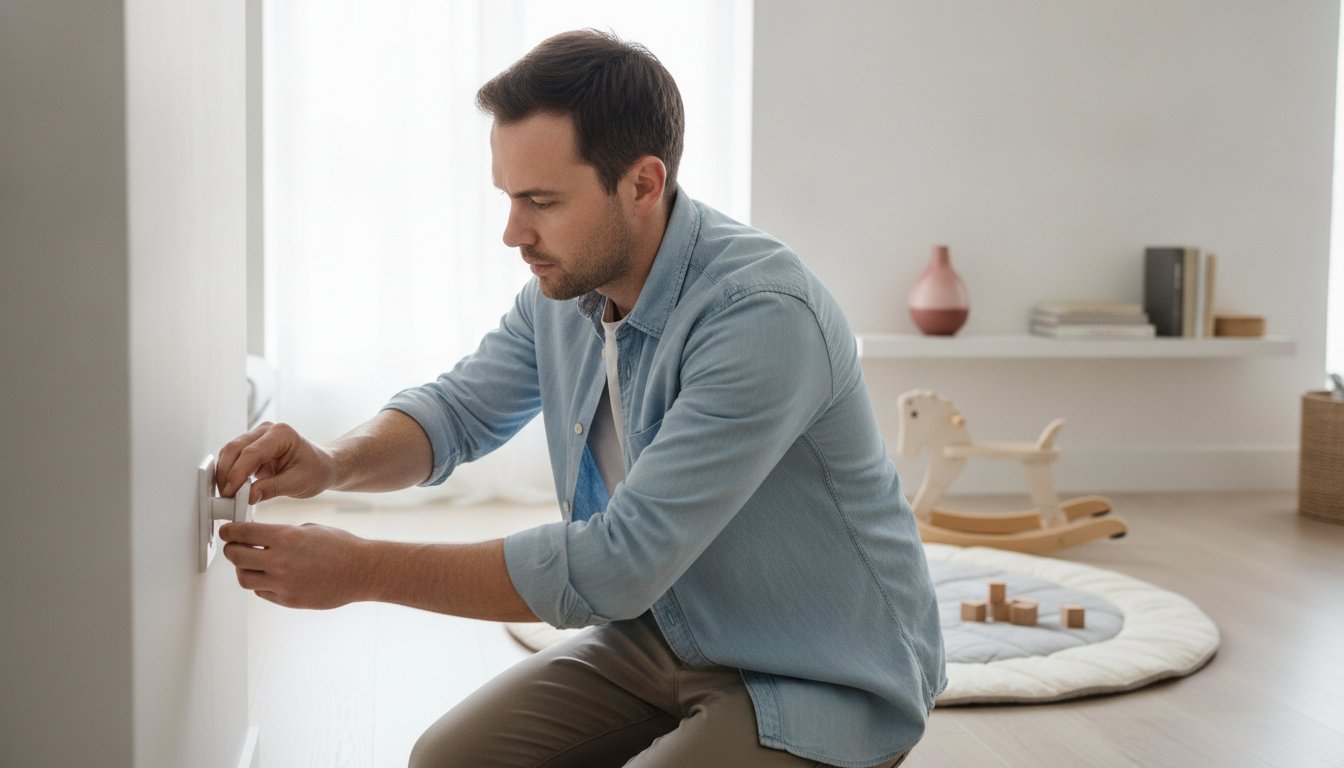
Here’s something no one warns you about: the moment your baby starts showing signs of mobility, your entire home suddenly looks like an obstacle course designed by someone who really doesn’t like babies. That cabinet under the sink. The wobbly bookshelf. The electrical outlet right at eye level. It can feel like hazards are hiding absolutely everywhere.
And honestly? That overwhelm is completely valid. Most parents don’t know where to begin, which products actually matter, or whether they’ve already missed the window to start. You’re not behind, and you’re not being dramatic. This stuff is genuinely a lot to take in.
That’s exactly why we put together this baby proofing checklist for your home, built to walk you through every room, step by step, without the noise or the fear-mongering. What you’ll find here is a clear, prioritized guide grounded in AAP and CPSC safety standards, written to help you build what child development experts call a “yes space,” a home where your little one can explore freely and you can actually breathe. Let’s start from the front door and work our way through together.
Key Takeaways
- Using a room-by-room baby proofing checklist for your home helps you tackle hazards in a clear, prioritized order — so nothing slips through the cracks before your little one starts moving.
- Baby proofing isn’t a one-time event; your safety setup needs to evolve as your child moves from newborn to crawler to determined toddler, and this guide walks you through each phase.
- Some of the most serious hazards are the least obvious — including furniture tip-overs and lithium coin batteries — and knowing what to look for can make all the difference.
- A monthly home safety audit helps you catch worn-out latches and new developmental milestones before they become a problem, keeping your “yes space” truly safe over time.
- Every recommendation here is grounded in AAP and CPSC safety standards, so you can feel confident you’re focusing your energy on what actually matters most.
The Heart of Home Safety: Why a Baby Proofing Checklist is Your New Best Friend
Think of a thorough baby proofing checklist for your home as a gift you’re wrapping right now for your future, exhausted self. The one who’s running on three hours of sleep, holding a squirming eight-month-old, and suddenly realizing the cabinet under the bathroom sink is wide open. Doing the work now, before that moment arrives, is one of the most genuinely loving things you can do for both of you.
There’s a concept child development specialists call a “yes space”: an environment where your baby can roam, touch, and explore without you trailing behind with a constant stream of “no, don’t touch that” and “come away from there.” It sounds almost too simple, but the research backs it up. When babies are free to move and investigate safely, they build confidence, motor skills, and independence faster. And you? You get to actually enjoy watching them discover the world, instead of spending every waking minute on high alert.
When Should You Start Baby Proofing?
The honest answer: earlier than feels necessary. Many pediatric safety experts recommend starting your safety audit during the third trimester, before the baby arrives, simply because the logistics are so much easier when you’re not sleep-deprived and responsible for a tiny human every second of the day. Think of it as nesting with a purpose.
Once your baby is here, the clock moves faster than you expect. Most babies begin rolling between four and six months, and that’s your two-week warning to have high-priority tasks finished. Outlet covers in, furniture anchored, stair gates installed. Because the jump from “just lying there” to “surprisingly mobile” can happen over a single weekend.
Here’s the part most guides skip: baby proofing isn’t a single Saturday project you check off and forget. It’s an ongoing conversation with your home as your child hits new milestones. A latch that stops a crawler won’t stop a determined toddler who’s figured out levers.
Getting on Their Level: The Crawler’s Eye View
One of the most practical things you can do right now costs nothing. Get down on your hands and knees and actually crawl through each room. It sounds a little silly, but the perspective shift is genuinely eye-opening.
From floor level, you’ll notice things that are completely invisible when you’re standing: dangling blind cords, the gap behind the radiator, a loose carpet staple that looks exactly like something worth investigating when you’re eight months old and everything goes straight into your mouth. What reads as “tidy room” from adult height can reveal an entirely different landscape of shiny, grabbable hazards from eighteen inches off the ground.
- Look for “shiny temptations”: coins, pen caps, small batteries, and decorative objects that look like toys but are serious choking risks.
- Check cords and cables: phone chargers, lamp cords, and blind pulls all become fascinating at crawler height.
- Notice what wobbles: furniture that feels stable when you push it standing up may shift easily when a baby uses it to pull themselves upright.
This floor-level audit is the foundation of any solid baby proofing checklist for your home, because you simply can’t address what you can’t see. Give yourself twenty minutes per room, and bring a notepad. You’ll be surprised what you find.
Timing Your Checklist: What to Tackle Before Birth vs. Once They’re Mobile
Here’s the relief no one offers early enough: you don’t have to do everything at once. A well-timed baby proofing checklist for your home is built in phases, and spreading the work across your pregnancy and your baby’s first year is not procrastination. It’s actually smarter. Your budget stays manageable, your energy goes where it’s needed most, and you’re not over-engineering safety measures for a developmental stage that’s still months away.
The ‘Pre-Arrival’ Essentials
Before your baby takes a single breath in your home, three things deserve your immediate attention. None of them require a shopping cart full of gear, but each one carries serious weight.
- Set your water heater to 120°F. The AAP recommends this temperature to prevent scalding burns, which can happen in under five seconds at higher settings. It takes two minutes and a screwdriver, and it protects everyone in the house, not just the baby.
- Install smoke and carbon monoxide detectors on every floor. The CPSC recommends detectors inside every bedroom, outside sleeping areas, and on each level of the home. If yours are older than ten years, replace them now.
- Audit the nursery for a SIDS-safe sleep environment. This means a firm, flat mattress with a fitted sheet only. No bumpers, no pillows, no positioners. The AAP’s safe sleep guidelines are clear on this, and they’re worth reading in full before your due date.
The ‘On-the-Move’ Upgrades
Once your baby starts scooting, usually somewhere between six and ten months, the second phase of your checklist kicks in. This is when floor-level hazards and room transitions become the priority.
Gates first. Hardware-mounted gates belong at the top and bottom of stairs; they bolt directly into the wall studs and won’t give way under pressure. Pressure-mounted gates are fine for doorways where a fall isn’t the risk, like blocking access to the kitchen. Don’t swap them. A pressure-mounted gate at the top of stairs is one of the most common installation mistakes pediatric safety experts flag.
Cabinet locks next. Magnetic locks are genuinely parent-proof in the best way: invisible from the outside, opened only by a magnetic key you keep out of reach. Traditional spring latches work, but a determined toddler (and honestly, a tired parent) can defeat them faster than you’d expect.
While you’re securing cabinets, do a quick sweep for small objects using what safety experts call the choke tube test: any object that fits entirely inside a tube roughly 1.25 inches in diameter is a choking hazard for children under three and needs to be stored out of reach.
As your baby transitions from crawler to cruiser, furniture anchoring and corner guards move to the top of the list, but that’s a project for the next phase. For now, focus on what’s relevant to where your child actually is developmentally. If you’re still building out your gear list, our baby safety buyers guide can help you sort the must-haves from the marketing noise.
The Room-by-Room Baby Proofing Checklist: Securing Every Corner
Let’s get into the rooms themselves, because this is where a baby proofing checklist for your home stops being abstract and starts being genuinely useful. Every room has its own personality of risk, and knowing which hazards belong where helps you prioritize instead of panic-buying every safety gadget on the shelf.
Kitchen and Dining Hazards
The kitchen is, without question, the most dangerous room in your home for a mobile baby. Hot surfaces, sharp edges, heavy appliances, and cleaning chemicals all share the same compact space. The good news is that a few targeted changes go a long way.
- Stove knob covers: Not overkill. A curious toddler can turn a gas burner on in under three seconds. Knob covers add a simple barrier that requires two deliberate hand movements to open, which is usually enough to stop a child who’s just cruising past.
- The Back Burner Rule: This costs nothing and saves lives. Whenever you’re cooking, use the back burners and turn all pot handles toward the wall. A baby pulling themselves up on the stove door can grab a handle and pull boiling liquid down. It’s one of the most common pediatric burn scenarios, and one of the most preventable.
- Appliance tip-over risk: Most parents think about furniture tipping but overlook the refrigerator and dishwasher. An open dishwasher door can hold a toddler’s weight long enough for the unit to become unstable. Keep dishwashers latched when not actively loading, and consider anti-tip brackets for freestanding refrigerators if yours isn’t secured to cabinetry.
Living Area and Nursery Safety
Coffee tables are essentially baby-height obstacle courses with corners. Clear silicone corner guards are worth the slight aesthetic trade-off; they’re nearly invisible and stay put far better than foam options, which tend to peel away after a few weeks. For edge strips along longer surfaces, look for adhesive foam rail guards rated for repeated impact.
Blind cords deserve their own paragraph. Cordless window treatments are the only genuinely safe option, full stop. Looped cords are a strangulation hazard, and cord wind-ups or tie-downs, while better than nothing, are not a permanent fix. If replacing all your blinds at once feels like too much, start with the nursery and any room where your baby sleeps or plays unsupervised.
Speaking of the nursery: while you’re setting up your feeding station, it’s a good moment to check whether you can get a free breast pump through insurance, since many parents don’t realize this benefit is available to them until well after their baby arrives.
Bathroom and Laundry Room
Water is the hazard most parents underestimate indoors. A child can drown in less than two inches of water, which means toilet locks aren’t a quirky extra; they’re a genuine safety measure. They also prevent the time-honored toddler tradition of fishing toys, phones, and entire rolls of toilet paper into the bowl.
- Laundry pods: These must live in a high, locked cabinet, not under the sink, not on the dryer. Their bright colors and squishy texture make them look like toys, and ingestion is a pediatric emergency. The same rule applies to all detergents and cleaning products.
- Non-slip mats: Place one inside the tub and one on the floor outside it. As your baby transitions to sitting baths and eventually standing, the tub becomes a slip risk from both directions. Textured mats with strong suction cups are more reliable than adhesive strips, which degrade with repeated washing.
Run through this section of your baby proofing checklist for your home with a fresh eye every few months. What’s secured for a crawler needs reassessing the moment your child figures out how to stand and reach.

Addressing Stealth Hazards: Furniture Anchoring and Modern Tech
Some of the hazards that keep pediatric safety experts up at night aren’t the obvious ones. They’re hiding in plain sight: the dresser you’ve had for a decade, the remote control on the coffee table, the smart speaker charging on the shelf. This part of your baby proofing checklist for your home is specifically about the risks that rarely make the parenting blogs but absolutely deserve your attention.
Furniture Tip-Over Prevention
Here’s the physics that changes everything. When a toddler grabs an open dresser drawer and pulls themselves up, their entire body weight acts as a lever. The tipping point is lower than you’d ever guess, and it happens fast. The CPSC’s Anchor It! campaign reports that a child is injured by a tip-over every 60 minutes in the United States. That number includes short dressers, bookshelves, and TV stands, not just the towering pieces you’d expect.
Two anchoring options work well, and which one you choose depends on your walls:
- Anti-tip straps: Flexible, furniture-to-wall brackets that attach to a stud. These are the most common option and work for most dressers and bookshelves. Look for straps rated for the weight of your specific piece.
- L-brackets: Rigid metal brackets that bolt directly into both the furniture and the wall stud. These offer a stronger hold for heavier units like large wardrobes or solid wood dressers.
One practical note: always anchor into a wall stud, not just drywall. A stud finder costs less than $20 and is one of the most genuinely useful tools you’ll own through the toddler years.
Small Parts and Chemical Safety
Lithium coin batteries are the hazard that deserves far more attention than it gets in 2026. They power TV remotes, key fobs, small clocks, musical greeting cards, and a surprising number of smart home accessories. If swallowed, a coin battery can cause severe internal burns within two hours, even if the battery appears “dead.” The fix is straightforward: use a small piece of clear tape over battery compartments on any device your child could access, and store spares in a high, locked location.
High-powered magnet sets, the kind sold as desktop toys, present a similar emergency-level risk. If a child swallows two or more magnets separately, they can attract through intestinal walls and cause serious internal damage. These belong in a locked drawer, not on a low shelf or refrigerator door.
For a quick choking hazard check, try the toilet paper roll test: if an object fits completely through a standard cardboard tube, it’s a hazard for children under three. It’s a simple, free tool that works better than eyeballing.
Don’t overlook houseplants, either. Common varieties like pothos, peace lily, and philodendron are toxic if nibbled. The Poison Control Center’s plant safety list is worth bookmarking as a quick reference.
Finally, smart home devices introduce a tangle of cords for cameras, speakers, and hubs that can become both a strangulation risk and a chewing hazard. Route cables through cord covers or along baseboards, and keep charging cables elevated well out of reach.
If you’re still sorting through which safety products are worth the investment, our baby safety buyers guide breaks down the gear that genuinely earns its place in your home.
Maintaining the Safe Zone: Your Ongoing Home Safety Audit
Here’s the truth that most baby proofing guides quietly skip: finishing your checklist isn’t the finish line. It’s more like the starting gun. Because the home you carefully secured for a four-month-old who stays where you put them is a genuinely different challenge when that same child is sixteen months old, climbing the bookshelf, and deeply convinced they can reach the windowsill.
A monthly walkthrough takes about fifteen minutes and pays dividends far beyond what the time investment suggests. Check cabinet latches for looseness, corner guards for peeling edges, and gate hinges for wobble. Foam degrades faster than you’d expect, especially in high-traffic areas. A latch that clicked firmly three months ago may now give with a firm tug from a toddler who’s been practicing. Catching these things early is exactly what keeps your baby proofing checklist for your home working as a living system rather than a one-time project.
The Seasonal Safety Check
Twice a year, when the clocks change for daylight saving time, test every smoke and carbon monoxide detector in the house. It’s a built-in reminder that’s genuinely hard to forget. While you’re at it, pull open the junk drawer. You know the one. It has inevitably collected batteries, loose screws, pen caps, and at least one mystery coin. These are textbook choking hazards, and a locked or high cabinet is a better home for all of it.
As the weather warms up, walk your outdoor spaces with fresh eyes. Check fence latches, gate locks, and any gaps in fencing that a determined crawler could squeeze through. Outdoor furniture can shift over winter, and a table that was stable in October may wobble by April.
Empowering Your Explorer
There’s a balance worth naming here. The goal was never to wrap your child in bubble wrap. It was to remove catastrophic risks so that safe risks, the ones that build coordination, confidence, and resilience, can happen freely. A child who tumbles off a low cushion and recovers is learning something valuable. A child who pulls a dresser onto themselves is not.
That distinction is exactly why a well-maintained home reduces parental stress in ways that are hard to quantify until you feel it. When the environment is genuinely safe, you say “no” less. You hover less. You both relax more. That’s the yes space in action.
Start teaching “hot” and “no-touch” early, even before it seems like they understand. Consistent language, calm repetition, and pointing toward safe alternatives (“that’s hot, here’s your cup”) builds real comprehension faster than most parents expect.
And through all of it, your most powerful safety tool remains the one that doesn’t come in a box: your presence. No latch or anchor replaces active supervision. But a home built on a solid, updated baby proofing checklist for your home means your attention goes toward connection and play, not constant crisis management. You’ve done the work. Keep doing it. That’s exactly what good parenting looks like.
Your Safer Home Starts Today
You’ve covered a lot of ground here, and that matters. From anchoring the dresser in the nursery to swapping out looped blind cords, every step you take on your baby proofing checklist for your home is a quiet act of love for your child and for the version of yourself who just wants to stop holding their breath every time the baby heads toward a new corner of the room.
The biggest things to carry forward: start earlier than feels necessary, revisit your safety setup as your child hits new milestones, and don’t let the stealth hazards, coin batteries, tip-over risks, laundry pods, slip past you because they don’t make the obvious lists.
You don’t have to figure out the gear side of this alone, either. Our expert-reviewed, pediatrician-backed guide breaks down exactly what’s worth buying and what isn’t. Download the 2026 Baby Gear Safety Guide for trusted recommendations built on the latest CPSC standards, from moms who’ve genuinely been there.
You’re doing beautifully. Keep going.
Frequently Asked Questions About Baby Proofing Your Home
When is the best time to start baby proofing my home?
The third trimester is genuinely the sweet spot. You’re still mobile enough to get on your hands and knees for a floor-level audit, and you’re not yet managing a baby in one arm while trying to install a cabinet latch with the other. Pediatric safety experts consistently recommend completing your highest-priority tasks, smoke detectors, water heater temperature, and nursery setup, before your due date arrives.
Once your baby is here, watch for rolling as your cue to finish phase two. Most babies begin rolling between four and six months, and that’s your signal to have gates, outlet covers, and furniture anchors in place. The jump from “stays put” to “surprisingly fast crawler” can happen over a single weekend.
Do I really need to anchor my furniture if I’m always watching my baby?
Yes, and here’s the honest reason why: tip-overs happen in seconds, often in the same room as a watchful parent. The CPSC reports that a child is injured by a tip-over every 60 minutes in the United States. That statistic includes short dressers and bookshelves, not just tall wardrobes. A toddler using an open drawer as a climbing step creates a lever effect that moves faster than any parent can react.
Active supervision is irreplaceable, but it was never designed to substitute for anchoring. Think of furniture straps as the backup your attention can’t always be. They’re inexpensive, take about twenty minutes to install, and protect your child even on the days when life gets genuinely distracting.
What are the most common household items that are choking hazards?
The ones that catch parents off guard most often aren’t toys. Coin batteries from remote controls, key fobs, and musical greeting cards top the list because they’re small, shiny, and frequently within reach. Other common culprits include pen caps, loose change, button-style magnets, small hair ties, popped balloons, and the caps from marker pens. Essentially, anything that fits completely through a toilet paper roll is a hazard for children under three.
Kitchen and bathroom drawers are worth a dedicated sweep. A single junk drawer can contain a surprising collection of screws, rubber bands, twist ties, and mystery coins that have accumulated quietly over months. A locked or elevated cabinet is a much safer home for all of it.
How do I baby proof my home without it looking like a playground?
The good news is that baby proofing has genuinely improved aesthetically in recent years. Clear silicone corner guards are nearly invisible on coffee tables. Magnetic cabinet locks are completely hidden inside the cabinet door, with no visible hardware at all. Cordless blinds look cleaner than corded ones anyway. Many parents find that a thoughtfully baby-proofed home actually looks tidier, because the process forces you to clear out low-level clutter and relocate items that were never in great spots to begin with.
The trick is to choose products in finishes that match your existing hardware and to avoid over-installing. Focus your visible safety gear on the rooms where your baby actually spends time, and save the more utilitarian solutions for spaces like the laundry room where aesthetics matter less.
Are magnetic cabinet locks better than the plastic latches?
For most families, magnetic locks are the stronger long-term choice. They’re invisible from the outside, which means they don’t telegraph the mechanism to a curious toddler, and they require a magnetic key to open, which you keep out of reach. Traditional spring latches work, but a determined toddler can often defeat them with repeated pressure, and a tired parent can find them genuinely frustrating to operate one-handed while holding a baby.
That said, magnetic locks do require a small upfront investment and are slightly more involved to install. If budget is a constraint, spring latches on lower cabinets are meaningfully better than nothing, particularly for cabinets containing cleaning products or anything sharp. The most important cabinet to secure well is whichever one holds your most hazardous items.
What should I do if my baby swallows a button battery?
Go to the emergency room immediately. Don’t wait for symptoms, and don’t try to induce vomiting. A lithium coin battery can cause severe internal burns within two hours of ingestion, even if the battery is depleted. This is one of the few pediatric situations where the window for safe intervention is genuinely narrow, and time matters more than almost anything else. Call Poison Control at 1-800-222-1222 on the way if you want guidance, but don’t let that call delay getting to the ER.
Prevention is straightforward once you know the risk: a small strip of clear tape over battery compartments on any accessible device adds a meaningful barrier, and spare batteries should always live in a high, locked location rather than a kitchen drawer.
How can I baby proof my house if I’m a renter and can’t drill holes?
Renters have more options than most guides acknowledge. Freestanding baby gates that use pressure mounting work well in doorways where a fall risk isn’t present, like blocking a hallway or a room entrance. For furniture anchoring, some anti-tip straps use adhesive wall mounts rather than screws, though these are best suited to lighter pieces and should be checked regularly. Furniture feet can also be repositioned against walls to reduce tipping leverage without any wall contact at all.
For cabinets, adhesive magnetic locks and strap-style latches attach to the inside of cabinet doors without drilling. They’re not quite as sturdy as hardware-mounted versions, but they’re a real improvement over nothing. Before you install anything, check your lease carefully. Many landlords will allow stud-mounted anchors for safety purposes if you ask directly, especially with a security deposit already in place.
What plants are toxic to babies and should be removed from the home?
Some of the most popular houseplants are also among the most problematic for curious babies. Pothos, philodendron, peace lily, dieffenbachia, and snake plants all contain compounds that can cause mouth irritation, vomiting, or more serious symptoms if chewed or ingested. Aloe vera, which many families keep for burns, is also toxic if eaten. The Poison Control Center’s plant safety list is the most reliable reference for checking any specific variety in your home.
Removing plants isn’t your only option. Relocating them to high shelves, hanging planters, or rooms your baby doesn’t access is a practical middle ground. If you’re not sure whether a plant is safe, a quick check against the Poison Control list takes about thirty seconds and gives you a clear answer without the guesswork.
Disclaimer
Pregnancy Magazine content is based on the latest research and information available, but is not meant to be medical advice or instruction. See a medical professional for direction for your specific situation or case.
We strive to be objective in our buyer's guide reviews and usually compare a variety of products in a category. Pregnancy Magazine is supported by sales from referring links.


