
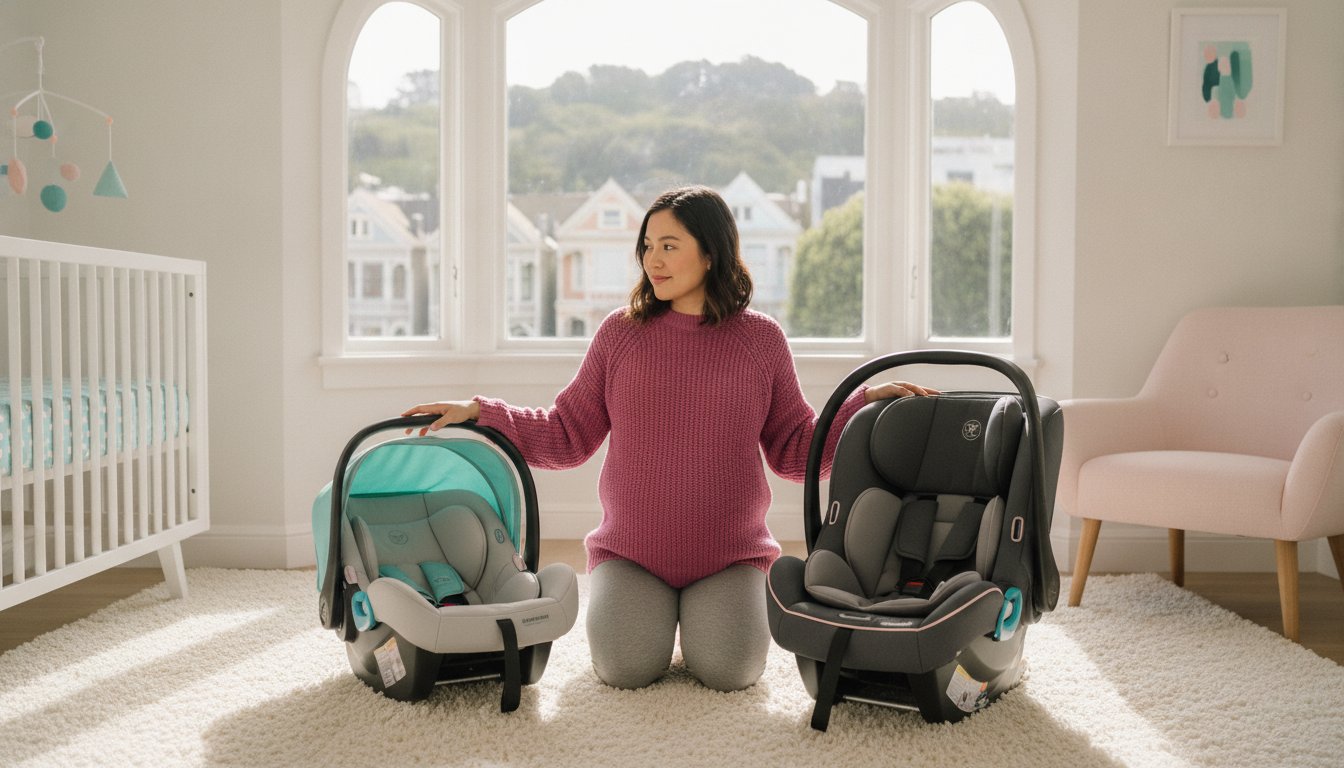
Let’s clear this up right away. The main difference between an infant seat and a convertible seat is how long they last and how they move. An infant seat is a rear-facing carrier designed for roughly the first 12 to 18 months, whereas a convertible seat is a larger unit that grows with your child from newborn to toddlerhood. Portability is the primary difference in the convertible car seat vs infant car seat debate, as carriers click out of the car while convertibles stay installed.
Standing in the baby gear aisle, it’s easy to feel a wave of overwhelm. The sheer number of choices is dizzying, but no decision feels more monumental than choosing the right car seat. You’re not just buying a piece of gear; you’re choosing the protective bubble that will bring your baby home from the hospital. The biggest question on every parent’s mind is: do we start with a portable infant seat or go straight to a long-lasting convertible one?
One path offers incredible convenience for those early newborn days, while the other promises long-term value and sustainability. Neither is right or wrong—it’s about what’s right for your family, your lifestyle, and your budget. In this guide, we’ll walk through every angle, from the physical realities of postpartum recovery to the nitty-gritty of installation, so you can make your choice with total confidence.
As you prepare for this new chapter, finding ways to maintain a balanced and inspired lifestyle—like those suggested by Wellthy—can help you navigate the transition with more ease and joy.
Table of Contents
- Understanding the Two Paths: Infant vs. Convertible Car Seats
- The Infant Car Seat: Why Convenience Often Wins in the Fourth Trimester
- The Convertible Car Seat: Is Skipping the Infant Phase Right for You?
- The Ultimate Comparison: Lifestyle, Safety, and Long-Term Value
- Making Your Decision: Installation, Safety, and Next Steps
Understanding the Two Paths: Infant vs. Convertible Car Seats
Let’s start by demystifying these two options so you know exactly what you’re choosing between.
- Infant Car Seat: This is a small, portable seat with a carrier handle, designed exclusively for newborns and infants. It only faces the rear of the vehicle and is generally used for the first 12 to 18 months.
- Convertible Car Seat: This is a larger, multi-stage seat that "converts" from rear-facing for newborns and toddlers to forward-facing as your child grows. It stays installed in your car.
- The Core Difference: The choice boils down to portability versus permanence. Infant seats offer "click-in" convenience with a base and stroller, while convertible seats offer a "one-and-done" purchase that remains fixed in your vehicle.
- The 2026 Mindset: More and more parents are weighing the "one-and-done" approach, hoping to reduce waste and make a more sustainable, long-term investment from day one.
The Anatomy of an Infant Carrier
The main appeal of an infant car seat is its clever two-part design.
- The Stay-in-Car Base: You install a base in your vehicle, and it stays there. The carrier simply clicks in and out, which makes transferring a sleeping baby a breeze. A green indicator usually confirms it’s locked in securely.
- Ergonomic Carry Handle: The handle makes it easy to carry your baby from the car to the house or into a store without unbuckling them. It’s a feature you’ll appreciate more than you can imagine.
- Travel System Compatibility: This is the primary selling point. Most infant carriers are designed to click directly onto a matching stroller, creating what’s known as a "travel system."
The Anatomy of a Convertible Seat
A convertible seat is built for the long haul, adapting as your child grows.
- Multi-Mode Functionality: These seats transition from rear-facing to forward-facing and, in some "all-in-one" models, even transform into a high-back or backless booster seat for school-aged kids.
- A Bulkier Footprint: Because they need to accommodate a 5-pound newborn and a 65-pound child, these seats are significantly larger and heavier. They are designed to be installed and rarely moved.
- Extended Rear-Facing (ERF): Convertible seats have higher height and weight limits for rear-facing, which is the safest way for young children to ride. This allows you to keep your child rear-facing for much longer, a key safety advantage.
The Infant Car Seat: Why Convenience Often Wins in the Fourth Trimester
For many new parents, the ease of an infant carrier makes it the clear winner for the newborn stage.
- The Transferability Factor: There is nothing more precious than a sleeping baby. An infant seat lets you move your little one from the car to the house, stroller, or shopping cart without waking them.
- Postpartum Recovery: A lightweight carrier may be easier to manage as your body heals. Whether you’re recovering from a C-section or navigating the challenges of a perineal tear, less heavy lifting can make a real difference.
- Travel System Synergy: Clicking the car seat directly onto a stroller frame creates a seamless cocoon for your baby during errands. It simplifies everything from pediatrician visits to grocery runs.
- Weather Benefits: In cold or rainy climates, you can buckle your baby into their seat in the warmth and comfort of your home before carrying them out to the car.
The "Click and Go" Lifestyle
The infant seat is designed for a life in motion. It supports quick trips and simplifies the logistics of leaving the house with a newborn. For families with more than one vehicle, you can purchase extra bases, allowing you to click the same carrier into either car without having to reinstall a whole seat each time. It’s a huge time-saver.
However, it’s important to use this convenience safely. While it’s tempting to let a sleeping baby nap in their carrier, research suggests that car seats are designed for travel, not for extended sleep outside of the vehicle, as the semi-upright position can affect a baby’s breathing.
Stroller Compatibility and Travel Systems
If you haven’t started stroller shopping yet, a "Travel System" is a bundle that includes an infant car seat, a stay-in-car base, and a stroller that are all designed to work together perfectly. It’s an incredibly popular choice for first-time parents because it takes the guesswork out of compatibility.
If you fall in love with a stroller from one brand and a car seat from another, don’t worry. Many companies sell universal adapters that can bridge the gap. Before you buy, always double-check the manufacturers’ websites to confirm that your dream stroller and chosen infant seat can be safely paired.
The Convertible Car Seat: Is Skipping the Infant Phase Right for You?
Opting for a convertible seat from day one is a practical, forward-thinking choice that comes with its own set of compelling benefits.
- Financial Longevity: This is the biggest draw. You make one purchase that can potentially last from the hospital ride home until your child is ready for kindergarten, saving you the cost of buying a second seat later.
- Robust Safety Features: Due to their larger, heavier frames, many convertible seats offer enhanced features like steel-reinforced frames and advanced side-impact protection.
- Extended Rear-Facing (ERF): This is a major safety advantage. Convertible seats are the gold standard for keeping children rear-facing as long as possible, which is the safest way for them to travel.
- Environmental Impact: By purchasing one seat instead of two, you’re creating less plastic and foam waste, which is a growing consideration for eco-conscious parents.
Newborn Fit in a Convertible Seat
The most common concern parents have is whether a tiny newborn will be safe and snug in such a large seat. Manufacturers have addressed this with special features for the smallest passengers. Look for a model that includes plush, removable infant inserts that provide extra support for a baby’s head, neck, and body.
You’ll also want to check the harness slot height. For a tiny newborn, the shoulder straps must be positioned at or just below their shoulders when rear-facing. A seat with low bottom harness slots is essential for a proper fit. Remember that major safety organizations like ACOG recommend keeping children rear-facing for as long as possible to protect their developing head, neck, and spine in the event of a crash.
Installation Permanence and Vehicle Space
Convertible car seats are the definition of "set it and forget it." Once you achieve a secure installation, you rarely have to touch it again until your child is ready to switch to forward-facing. This permanence can provide great peace of mind.
However, their size requires some planning. In smaller cars, a bulky convertible seat installed rear-facing can significantly reduce the legroom for the driver or front passenger. It’s wise to measure your back seat or even test-install a floor model before buying. And remember, with a fixed seat, you will need a separate way to carry your baby on outings, such as a bassinet stroller, a wrap, or a soft-structured carrier.

The Ultimate Comparison: Lifestyle, Safety, and Long-Term Value
The right car seat isn’t just about specs—it’s about how it fits into the rhythm of your daily life.
- Urban vs. Suburban Life: If you live in a city and rely on taxis, Ubers, or frequently switch cars, the portability of an infant carrier is invaluable. Suburban families who primarily use their own vehicle may find the permanence of a convertible seat more practical.
- The "Second Child" Strategy: Many families find a happy medium. They use an infant carrier for their first baby and then, when the second baby arrives, the newborn gets the hand-me-down infant seat while the older toddler continues to use their convertible seat.
- Budgeting for Baby Gear: A convertible seat has a higher upfront cost but is cheaper in the long run. An infant seat is less expensive initially, but you’ll need to budget for a convertible seat a year or so later. Balancing your registry can help; for example, you might be able to get a free breast pump through insurance, freeing up funds for your car seat choice.
Safety Standards and 2026 Innovations
It’s important to know that both seat types are equally safe when they are installed and used correctly according to the manufacturer’s manual. All car seats sold in the U.S. must meet the same strict Federal Motor Vehicle Safety Standards (FMVSS). The best seat is the one that fits your child, fits your vehicle, and that you can use correctly 100% of the time.
In 2026, we’re seeing exciting innovations in car seat technology. The rise of "Smart Seats" with sensors that alert you if a child is left in the car or if the chest clip becomes unbuckled is adding a new layer of peace of mind for parents.
The "Heavy Lifting" Reality Check
Don’t underestimate the physical side of this decision. An infant carrier might only weigh 10 pounds, but add a 15-pound baby, and you’re suddenly carrying 25 pounds on one arm. For parents with back issues or those who live in a walk-up apartment, this can become challenging quickly.
In these cases, a convertible seat combined with a lightweight baby carrier (like a wrap or buckle carrier) can be a perfect solution. You get the benefit of a fixed car seat and can still carry your baby close to you, hands-free, without the awkward bulk of a car seat carrier.
Making Your Decision: Installation, Safety, and Next Steps
Feeling ready to choose? Here’s a simple four-step plan to guide you to the perfect car seat for your family.
- Measure Your Vehicle: Before you shop, take a look at your car’s back seat. Note the space you have and locate the LATCH anchors, which are the standard system for easy car seat installation.
- Decide on Your Stroller Strategy: Do you love the idea of a seamless Travel System, or do you prefer a separate stroller with a bassinet or newborn-ready seat? Your stroller preference will heavily influence your car seat choice.
- Check the Harness Fit: When you have a seat in hand, practice using the harness. You’ll want to perform the "pinch test" to ensure a secure fit: if you can pinch a horizontal fold of webbing at your baby’s collarbone, it’s too loose.
- Get a Professional Check: The single most important thing you can do is have your installation verified. Find a local certified Child Passenger Safety Technician (CPST) or a car seat inspection station to ensure your seat is installed perfectly.
When to Make the Switch
If you choose an infant seat, you’ll need to know when it’s time to graduate to a convertible model. Your baby has outgrown their infant seat when they reach either the maximum height or weight limit, whichever comes first. The most common sign is the "1-inch rule": when the top of your baby’s head is less than one inch from the top of the carrier’s shell, it’s time to switch.
Car Seat Maintenance and Longevity
Car seats are safety devices that require a bit of care. Always check your manual for specific instructions on how to clean your car seat, as using harsh chemicals can compromise the integrity of the harness straps. Also, be sure to check the expiration date, which is usually stamped into the plastic on the back or bottom of the seat (typically 6–10 years from the date of manufacture).
Finally, remember the "One Crash" rule. Any car seat that has been involved in a moderate to severe accident must be replaced, even if it looks undamaged. Your car insurance may even cover the cost of a replacement.
Frequently Asked Questions
Is a convertible car seat safe for a newborn?
Yes, absolutely. As long as the convertible car seat is rated for a newborn’s weight (e.g., starting at 4 or 5 pounds) and includes proper infant inserts for a snug fit, it is just as safe as an infant carrier when installed correctly in the rear-facing position.
When should I switch from an infant car seat to a convertible car seat?
You must switch when your baby reaches either the maximum height OR weight limit specified by the manufacturer. Most babies outgrow their infant seats by height first, typically when their head is within one inch of the top of the seat’s shell.
Can I use an infant car seat without the base?
Most infant car seats sold in the U.S. can be safely installed without the base using the vehicle’s seat belt. This is called a "European belt path" and is very convenient for travel or city living with taxis. Always check your specific car seat manual to confirm it has this feature and to learn the correct installation method.
Do convertible car seats fit in small cars?
Many do, but it requires careful research. Look for "slim fit" or "compact" convertible car seats designed specifically for smaller vehicles. It’s always a good idea to measure your back seat and compare it to the seat’s dimensions before purchasing.
Is it worth buying a used car seat?
Experts strongly advise against it. A used car seat could have an unknown history—it may have been in a crash, cleaned with harsh chemicals, or be past its expiration date. Unless you are getting it from a trusted family member or friend who can guarantee its history, it’s safest to buy new.
How long do infant car seats typically last before babies outgrow them?
Most babies outgrow their infant car seats between 9 and 18 months, depending on the seat’s limits and the baby’s individual growth curve. They almost always outgrow them by height before they reach the weight limit.
What is the 2-hour rule for babies in car seats?
The "2-hour rule" is a general safety recommendation that suggests a baby should not be in a car seat for more than two hours in a 24-hour period. This is to prevent potential issues with breathing and spine development from being in a semi-upright position for too long. If you’re on a long road trip, plan to take frequent breaks to get the baby out of the seat.
Do all infant car seats fit all strollers?
No, they do not. Compatibility is brand-specific. The easiest way to ensure a fit is to buy a "travel system." Otherwise, you’ll need to check with both the car seat and stroller manufacturers to see if they are compatible or if an adapter is available to connect them.
Disclaimer
Pregnancy Magazine content is based on the latest research and information available, but is not meant to be medical advice or instruction. See a medical professional for direction for your specific situation or case.
We strive to be objective in our buyer's guide reviews and usually compare a variety of products in a category. Pregnancy Magazine is supported by sales from referring links.


